
Short answer: a test de purete en couple works best as two individual quiz sessions followed by an optional conversation. Agree on what is off limits, let either person skip a question, and never demand screenshots or an itemised answer list. The score describes answers in one playful questionnaire; it does not measure trust, attraction, fidelity, maturity or compatibility.
This page focuses on the couple task behind the search phrase. If you came here because you are unsure whether to write test de purete or test de pureté, use the spelling guide instead. If you want a larger friend-group format, the guide to test de purete a plusieurs covers that boundary. A partner session needs its own rules because the emotional stakes and the privacy expectations are different.
What “test de purete en couple” means
The phrase usually describes a purity-style questionnaire taken by two partners who want to compare experiences or start a conversation. It does not automatically mean that a website has a synchronized couple mode. Most online quizzes still create one result per browser session. You can use the same link twice, but you should treat the sessions as separate unless the page clearly explains a shared feature.
The couple setting changes the way you use the quiz, not what the score proves. One partner may answer more questions because a particular version includes different age, culture or relationship assumptions. A high or low number can be interesting to discuss, yet it is not a test of who is more honest or who is “better” at relationships. The value comes from choosing a comfortable format and learning what each person wants to share.
Agree on rules before a test de purete en couple
A two-minute agreement prevents most awkward moments in a test de purete en couple. Decide whether you will answer in the same room, on separate devices or at different times. Decide what “sharing” means: a final range, a single number, a few stories, or nothing at all. Both people should be able to change their mind after seeing a question.
- Make participation voluntary. A partner can decline the activity without having to explain why. “Not today” is a complete answer.
- Create a pass rule. Use the quiz skip control when available. If there is no skip control, pause or close the page instead of forcing an answer.
- Keep answers private by default. Do not look over a screen, read a partner’s history or request a screenshot. A shared result is a gift, not evidence owed to the other person.
- Set an age and content boundary. Choose a version appropriate for both people. Adult labels such as “hard” or “spicy” are not invitations to ignore comfort or consent.
- Choose a stopping signal. A word, gesture or simple pause lets either person end the conversation without debate.
These rules are useful whether you are together in person or playing remotely. They also prevent a common mistake in a test de purete en couple: treating a playful score as a contract that someone must explain. If the quiz includes sexual or sensitive questions, remember that a relationship does not remove a person’s right to privacy.
How to choose questions for a test de purete en couple
There is no single correct list of questions for a test de purete en couple. Start with the lightest level that both partners accept, then move only when the conversation still feels easy. The categories below are a planning tool, not a ranking of intimacy.
| Level | Good fit | Boundary to keep |
|---|---|---|
| Light | Travel, harmless dares, parties, first impressions or funny mistakes. | Keep the tone playful; do not turn an answer into a test of loyalty. |
| Personal | Past relationships, communication habits, secrets that are safe to discuss and expectations. | Ask whether the person wants a follow-up before requesting details. |
| Intimate | Only topics both partners name as comfortable, with an explicit option to skip. | Never use a score or disclosure to negotiate consent. |
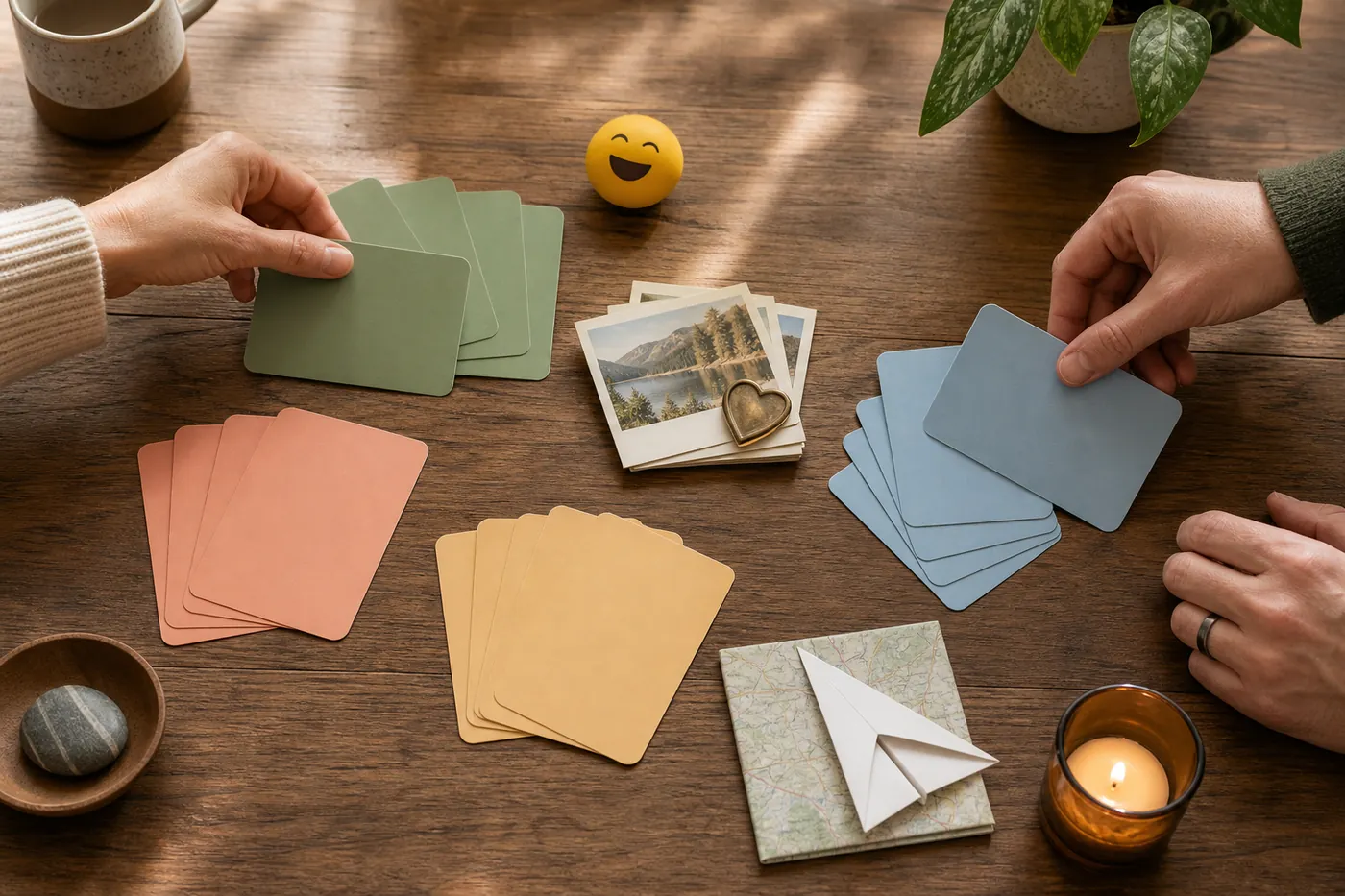
Question wording matters in a test de purete en couple. “Have you ever…?” invites a private memory, while “Why did you…?” can sound like an interrogation. Use neutral language, avoid guessing a partner’s answer and leave room for context. Two people can answer “yes” to the same item for completely different reasons; the checkbox is not a complete story.
Answer privately after a test de purete en couple
The cleanest test de purete en couple workflow is simple: open the same quiz, answer separately and meet afterward. If you share one device, take turns with the screen turned away. If you play remotely, send the public quiz link rather than a photo of your answers. A call can be a good place to compare broad ranges, but it should never become a live audit.
Decide in advance what counts as a comparison in a test de purete en couple. Some couples share only “higher,” “middle” or “lower.” Others discuss one funny, non-sensitive question. Both approaches are valid. Avoid a leaderboard, a surprise reveal or a rule that the lower score must justify itself. When a score difference feels tense, return to the question wording and the version of the quiz before making assumptions.

How to read a test de purete en couple score
A score from a test de purete en couple is tied to the exact quiz, its number of items and its scoring rule. Two versions can use the same label but produce different ranges. Before comparing, write down the quiz name, the number of questions and whether a “yes” raises or lowers the displayed number. Without that context, a numerical difference is easy to overread.
| A score can help you… | A score cannot tell you… |
|---|---|
| Start a light conversation about different experiences. | Who is trustworthy, mature, faithful or ready for a commitment. |
| Notice which topics you both want to discuss or avoid. | Whether consent was present, whether a relationship is safe or whether a partner owes details. |
| Choose a follow-up activity, such as the site's conversation questions. | Whether you are compatible. Use a dedicated compatibility quiz for that separate prompt. |
If you want help understanding a number, the site's score interpretation tool explains ranges while keeping the result non-diagnostic. You can also take the Rice-style purity quiz independently. The important distinction is that a playful result can support reflection, but it cannot replace a conversation about boundaries or a professional assessment.
A simple test de purete en couple session plan
- Pick the version. Check the question count, content label and score direction. Avoid a version that hides its privacy or billing terms.
- Agree on the rules. Confirm the pass option, the stopping signal and the default privacy setting.
- Answer alone. Use separate screens or take turns without watching. Give each person enough time to think.
- Save only what you choose. A partner can keep a score private. Do not store sensitive answers in a shared chat or public post.
- Compare gently. Start with the broad result, then ask “Would you like to discuss any part?” instead of asking for proof.
- Close the activity. Finish with something unrelated to the score: a walk, a meal or a lighter question. This keeps the quiz from becoming the mood of the evening.
Use this test de purete en couple plan when both people want a short, private activity. For a conversation without any score, use the site's guide to questions for couples. For a larger group, switch to the friends and group format. These routes are complementary rather than interchangeable: each one sets a different audience and boundary.
Frequently asked questions
Can couples take a test de purete en couple together?
Yes. In a test de purete en couple, each partner can answer the same quiz in a private session, then decide whether to discuss the result. A couple format should not require a shared score or public answers.
Should partners answer every question?
No. In a test de purete en couple, agree that either person can skip, pause or stop. A score is not comparable when one partner answers under pressure, and no quiz is more important than a clear boundary.
Is a purity score a measure of couple compatibility?
No. A test de purete en couple score is a playful summary of one quiz version. It does not measure trust, consent, communication, maturity or compatibility.
Can we take the quiz remotely?
Yes. For a test de purete en couple at a distance, share the public link, answer separately and schedule a conversation only if both people want one. Do not ask for screenshots or an itemised answer list.
What if our scores are very different?
In a test de purete en couple, treat the difference as a prompt for a respectful conversation, not evidence of a problem. Scores depend on the quiz, the wording and what each person chose to answer.