Short answer: test de pureté inclusif usually means a purity-style questionnaire that does not assume one gender, orientation, relationship model or life path. It should let people recognise themselves in the wording, skip what does not fit and understand how answers are handled. The phrase test de pureté lgbt may point to the same need, but an inclusive quiz is not automatically an orientation test.
This distinction matters because “inclusive” can describe the design of a questionnaire rather than a score category. A welcoming page explains who it is for, which experiences it covers and what the result can and cannot say. It does not ask users to prove an identity, disclose a private story or accept a label they did not choose. This guide gives you a practical way to review a quiz before answering.
What does test de pureté inclusif mean?
An inclusive purity quiz keeps the familiar idea of a life-experience questionnaire while widening the assumptions behind its questions. Instead of treating one type of couple, body, attraction or social life as the default, it uses wording that can apply to more people. A question may refer to a partner rather than only a boyfriend or girlfriend, or ask whether a situation happened without forcing a gendered answer.
Inclusion also concerns what the quiz does not claim. A good page does not turn “pure” into a synonym for good, experienced into a synonym for risky or a particular identity into a score. It explains that people can have different histories and still receive the same number for completely different reasons. The number is a prompt for reflection, not a ranking of communities.
The term can overlap with searches such as test de pureté lgbt, quiz inclusif or diversité sexuelle. Those searches have different possible intentions. Some users want inclusive language in a general quiz; others want educational information about orientation or gender. Read the page purpose before assuming it will answer the question you had in mind.
Scope, wording and representation
Look at the question list rather than trusting a badge or a rainbow colour palette. Representation is useful only when it changes the experience: who can answer, which situations are acknowledged and whether the result page treats every response with the same respect.
| Check | Helpful signal | Warning sign |
|---|---|---|
| Audience | The page states whether it is general, adult, teen-friendly or educational. | One “universal” score is promised without explaining who the questions fit. |
| Language | Questions avoid unnecessary gender assumptions and explain unfamiliar terms. | Every situation presumes a heterosexual couple or one fixed body type. |
| Choices | You can choose “not applicable”, skip, go back or stop. | A forced answer is required even when the situation does not describe you. |
| Result | The result describes the questionnaire and keeps moral judgement out of the scale. | The score labels people as normal, abnormal, better or worse. |
| Data | The page says whether answers stay local, are stored or are shared. | A playful quiz requests a real name, private messages or unnecessary contact details. |
Do not confuse inclusion with an orientation test
An inclusive purity quiz can welcome LGBT users without measuring sexual orientation or gender identity. An orientation questionnaire has a different purpose: it may offer educational prompts about attraction, identity or labels. The orientation guide is the better starting point when that is your actual question. Keeping the purposes separate protects readers from treating a playful purity number as evidence about who they are.
How to choose a welcoming questionnaire
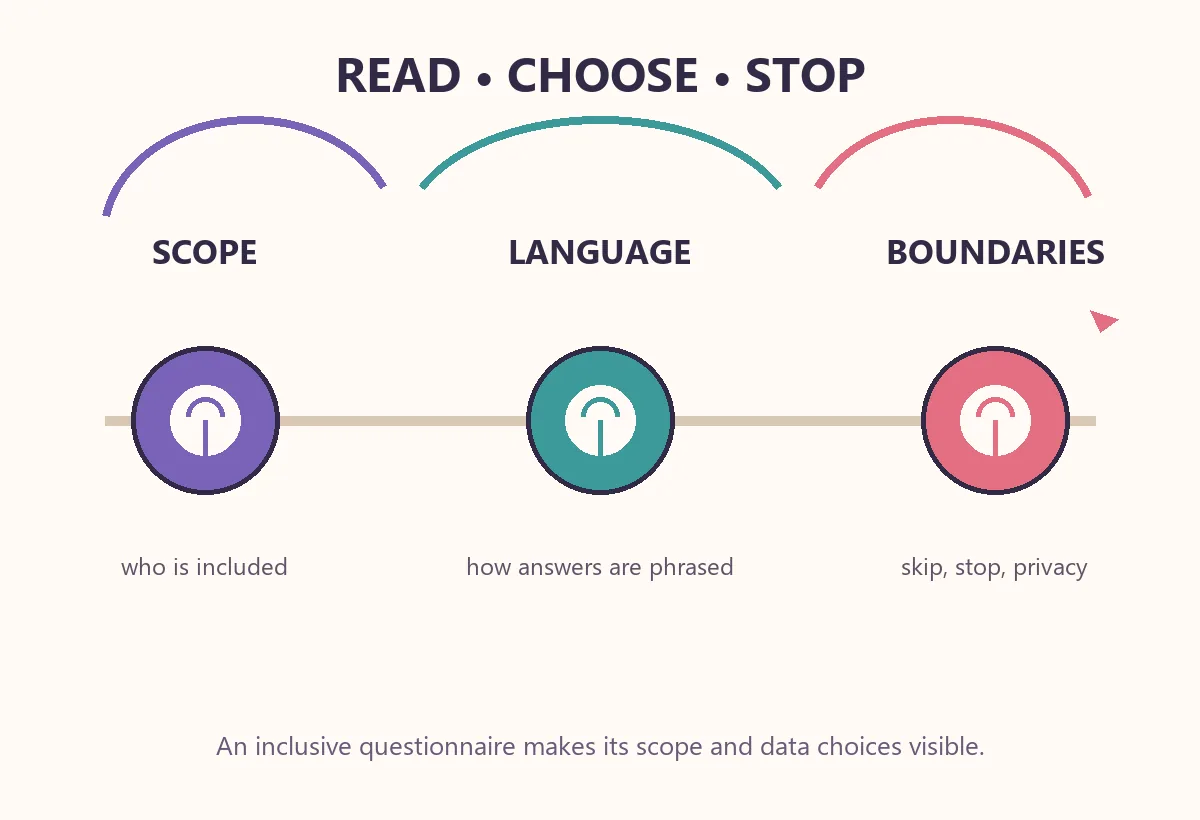
Use this short review before you answer. It takes less time than completing a quiz and helps you avoid a result that feels confusing or intrusive.
- Read the one-sentence purpose: decide whether the page is a general purity quiz, an adult version, an identity education resource or a conversation starter.
- Preview the strongest questions: scan for topics involving intimacy, relationships, health, safety or personal history. You can leave when the scope is not right for you.
- Check the answer model: a useful questionnaire offers “not applicable”, “prefer not to say” or a skip path when a yes/no answer would misrepresent your experience.
- Check age guidance: an adult label belongs on an adult page. Younger readers should use the site's age-appropriate test instead of navigating through mature content.
- Check the result language: look for a neutral explanation of what the number summarises. Avoid pages that use shame, stereotypes or a fake promise of scientific certainty.
- Check the exit: you should be able to stop, close the page or reset without losing control of your device or sharing a private account.
General, adult and inclusive are different labels
“Inclusive” describes who can be represented. “Adult” describes the intensity or age range of the content. They can overlap, but one does not replace the other. A general inclusive quiz may still be unsuitable for a young reader if its questions are mature. An adult quiz may mention different identities but still use narrow assumptions. Always check both dimensions.
Boundaries, consent and privacy
Your answer is optional even when a page does not make that obvious. Consent applies to the quiz experience itself: you choose whether to begin, which questions to answer and whether to discuss the result with someone else. A partner, friend or group should never pressure you to reveal a response just because the quiz is being taken together.
Privacy has two layers. First, consider the content of an answer. A question about relationships, attraction or health can be sensitive even when the page calls the quiz “just for fun”. Second, consider the technical handling. A local calculation that stays in the browser has a different risk from a form that sends responses to a server. Read the privacy page, avoid real names and do not grant access that the quiz does not need.
If you are creating a quiz for a community, write the boundaries before the questions. State the audience, define respectful language, explain how “not applicable” works and give a clear contact or reporting path for harmful wording. Inclusion is an ongoing editorial choice, not a decorative label added after the scoring logic.
How to read an inclusive purity result
Interpret the number inside the quiz that produced it. Different questionnaires use different item counts, response directions and categories, so a score of 70 on one page cannot be compared directly with 70 on another. Even a carefully written inclusive quiz is still a limited snapshot of selected answers.
Ask what the result helps you notice rather than what it proves. Did the questions reflect your experiences? Did you skip items because they did not apply, because you wanted privacy or because the wording was unclear? Those reasons matter more than a label such as “pure” or “impure”. If you want to understand how a number is built, the site's score interpretation guide explains the limits of purity scales.
Do not use the result to make decisions about identity, consent, health or compatibility. A quiz can start a conversation, but it cannot replace a trusted person, an informed resource or professional support when the subject is serious. For a broad, non-specialised questionnaire, the Rice-style test is a clearer destination; for adult topics, review the adult test and its boundaries first.
FAQ about test de pureté inclusif
What does test de pureté inclusif mean?
It usually means a purity-style quiz that avoids assuming one gender, orientation, relationship model or life path. The question list still determines how inclusive the experience really is.
Is an inclusive purity quiz an LGBT test?
Not automatically. It can welcome LGBT users without measuring orientation or gender identity. A dedicated orientation questionnaire has a different purpose and should say so clearly.
Can I skip a question?
You should be able to skip or stop when a question does not fit your experience or crosses a personal boundary. Voluntary participation matters more than completing every item.
Does the score measure identity or maturity?
No. It summarises answers in one playful questionnaire. It cannot diagnose identity, measure maturity, prove compatibility or rank one life experience above another.
How can I check privacy before taking a quiz?
Look for a plain-language privacy notice, avoid unnecessary names or contact details, check whether answers stay in the browser and never share another person's responses without permission.
Summary
Test de pureté inclusif is best understood as a design and language promise, not a scientific score type. Check the scope, look for neutral wording and a skip path, confirm the age level, read the privacy explanation and keep your own boundaries in charge. The related phrase test de pureté lgbt can describe an inclusive audience, but it should not be used to make assumptions about identity. A respectful quiz gives you room to answer, pause or leave.