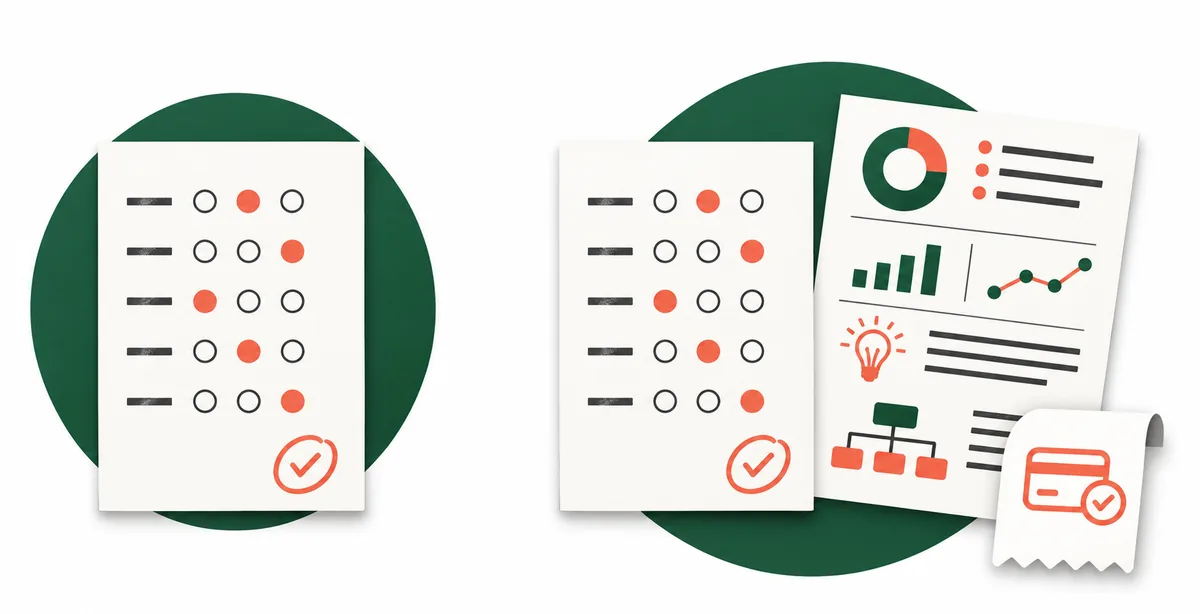
Short answer: choose a free test when its questions and result already meet your goal. Consider paying only when a paid report gives you a specific, clearly priced item you plan to use. The phrase tests gratuits vs payants is not a choice between “bad” and “good”: compare what a free test provides, what the paid report adds, and what the checkout terms mean.
An online quiz can be a light activity, a self-reflection prompt, or a more structured questionnaire. Those are different jobs. Before starting a free test, decide whether you want a quick score, a longer explanation, a saved report, or an assessment for a consequential decision. Then compare the actual deliverables rather than assuming that a paid test signals quality.
What can “free” and “paid” mean?
A test page may use “free” for the questions while charging for a detailed result. Another may show a sample result and sell a report, offer an optional subscription, or provide everything without a charge. These models can look similar until the final step, so read the description before entering an email or payment details.
| Offer type | What may be included | What to check |
|---|---|---|
| Free test result | Questions, a score, and a short explanation. | Whether the result is visible without registration and how answers are handled. |
| Free start, paid report | A basic result at no charge, with a longer interpretation or download offered separately. | Which parts are free, what the report adds, and whether payment is optional. |
| One-time purchase | A stated report, saved result, or other named item for a single payment. | The full amount, currency, delivery, refund terms, and whether any renewal follows. |
| Trial or subscription | Initial access followed by recurring billing, or a membership that unlocks more tests. | When the first charge happens, the renewal frequency, cancellation steps, and final price. |
What might a paid report add?
A paid report can be worthwhile when it gives you something concrete you planned to use: a clear explanation of the score, examples tied to your answers, a printable copy, or access to additional content. A longer report can also make a result easier to understand. These are features, not proof that the test measures a trait accurately.
Look for a preview or a plain-language list of what is included in the paid report. “Personalized insights” is vague unless the provider explains what is personalized. If the paid report repeats the score you can already see, or the description hides its contents, pause before buying. You do not need an upgraded result merely because the page presents one.
What payment cannot prove
Price does not tell you whether a questionnaire is standardized, validated for a particular purpose, or interpreted by a qualified professional. The American Psychological Association describes a psychological test as a standardized instrument, including scales and self-report inventories, used to measure behavior or mental attributes. That definition is a useful reminder: a quiz that gives a score is not automatically a psychometric assessment.
For example, a purity quiz is generally a recreational self-report about experiences. Its score should not be treated as a diagnosis, a measure of personal worth, or a scientific ranking. If you are considering an IQ or mental-health test for a formal decision, check its stated method and intended use and seek appropriate professional guidance. A French article about online IQ tests also cautions that paying for a consumer quiz does not make it a reliable IQ evaluation; that point applies to IQ claims, not every kind of online questionnaire.
A six-point check before you pay
- Name your goal. Is this for entertainment, reflection, learning, or a decision that affects health, school, work, or another important area? A casual quiz should not be sold as a substitute for an assessment designed for formal use.
- Read the free result first. Find out whether the score and its basic meaning are available before payment. If the site asks you to pay before explaining what the test measures, you have little basis for judging the offer.
- List the paid additions. Write down what the paid report includes: examples, a saved copy, or another named feature. If you cannot name what changes, the upgrade may not solve a real need.
- Check the total and timing. Confirm whether the price is one-time or recurring, when billing begins, and whether a trial renews automatically. Note how and when you must cancel. Do not rely on a button label alone.
- Review privacy before sharing answers. Look for what data is collected, why it is used, whether an account is required, and how to delete data. Health, sex-life, and sexual-orientation details can be sensitive personal data; the CNIL explains these categories and the importance of a valid basis for processing.
- Separate a score from evidence. If the result claims to identify a condition, measure intelligence, or predict an outcome, look for the named instrument, its intended use, and who is responsible for interpretation. A polished report or a higher price is not a substitute for this information.
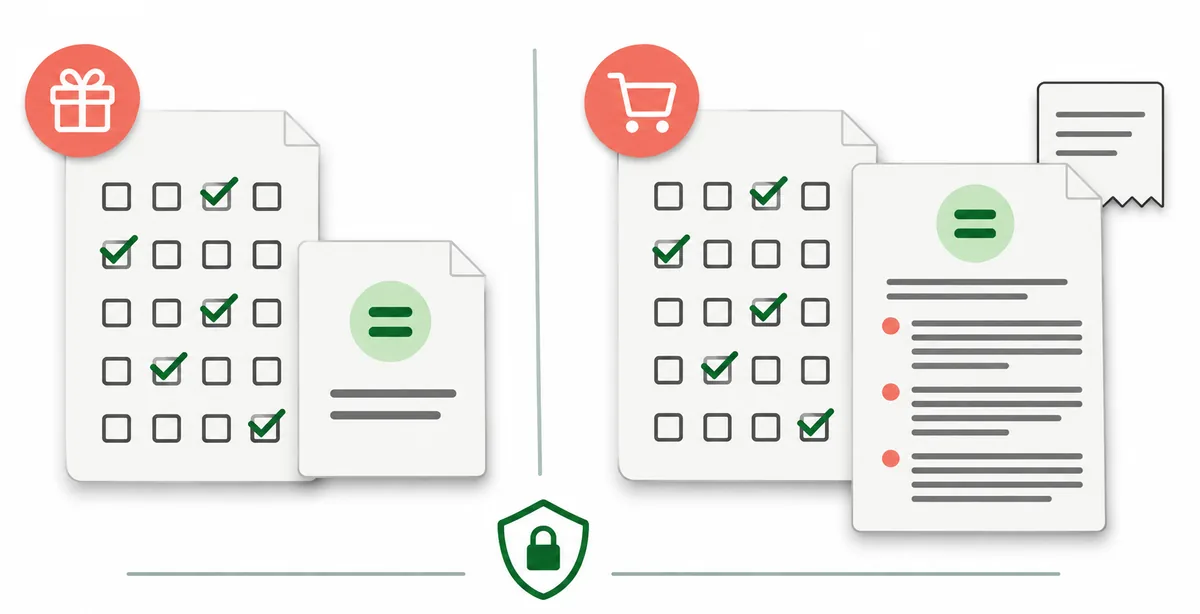
Compare the real cost, not just the first price
For a one-time purchase, compare the amount with the specific report you will receive. For a subscription, estimate the total for the period you expect to use it: add the first payment to each later renewal that would occur before cancellation. A low introductory offer may still cost more than a one-time report if you forget to cancel or do not need ongoing access.
Do not invent a price comparison when a site does not publish one. Instead, record the amount shown at checkout, the billing interval, and the cancellation deadline. If those details are missing or change between the offer and checkout, stop and ask the provider for clarification. If you cannot get a clear answer, choosing a no-cost alternative is reasonable.
When a free test is enough
A free test is often enough when you want to try a format, get a quick recreational score, or decide whether a topic interests you. For a Rice Purity Test or a Griffor quiz, the questions and basic result may be the whole activity. Compare the question scope and privacy information, then stop when the result answers your question.
When you are exploring a psychological topic, begin with the limits and purpose of the questionnaire. Our guide to online psychological tests explains why an online score needs context. For depression-related self-assessments, see the separate guide to questionnaires and mental well-being; it is not a diagnosis or a sales recommendation.
Frequently asked questions
Are free online tests always inaccurate?
No. Price alone cannot establish accuracy. Check what the test measures, how its score is produced, and whether its limits are explained. A free entertainment quiz can be useful for entertainment without claiming scientific validity.
Does a paid report make an online test more scientific?
No. A report may add explanation or examples, but payment does not prove that a questionnaire is standardized or validated for your intended use. Look for the method and scope separately.
How can I tell whether a free test will lead to a charge?
Read the terms before entering payment details. Check whether the offer is one-time or recurring, when billing starts, how cancellation works, and what remains available at no charge.
Should I pay for a purity test score?
For a casual purity quiz, a free test result may be enough. Pay only if a specific, transparent paid report is useful to you, and do not treat the result as a judgment or diagnosis.
Can I use an online IQ or mental-health quiz for a formal decision?
Do not assume a consumer quiz is suitable for diagnosis, school, work, or another formal decision. Check the instrument, intended use, qualifications, and guidance from an appropriate professional.
Sources
- APA Dictionary of Psychology: psychological test — definition of standardized psychological tests.
- CNIL: sensitive data — examples that include health, sex-life, and sexual-orientation data.
- Suivez le Zèbre: online IQ tests and paid assessments — an IQ-specific caution, updated February 20, 2023.